
Last updated: June 2026. All prices and transaction fees below have checked against provider pricing pages and independent UK reviews in June 2026. Fees exclude VAT unless stated and can change — always confirm on the provider’s website before signing up.
Cash is disappearing faster than most small business owners realise. According to UK Finance’s latest Payment Markets report, cash fell below 10% of all UK payments for the first time in 2024 — while debit cards alone accounted for 26.1 billion payments, roughly half of everything paid for in the country. More than half of UK adults are now registered to pay with a mobile wallet like Apple Pay or Google Pay.
For a small business, the message is simple: if you can’t take card and contactless payments, you’re turning customers away at the till.
The good news is that accepting cards has never been cheaper or easier. You no longer need a bank contract, a rental terminal, or a monthly minimum. In 2026 you can buy a card reader outright for as little as £19 and pay only when you sell.
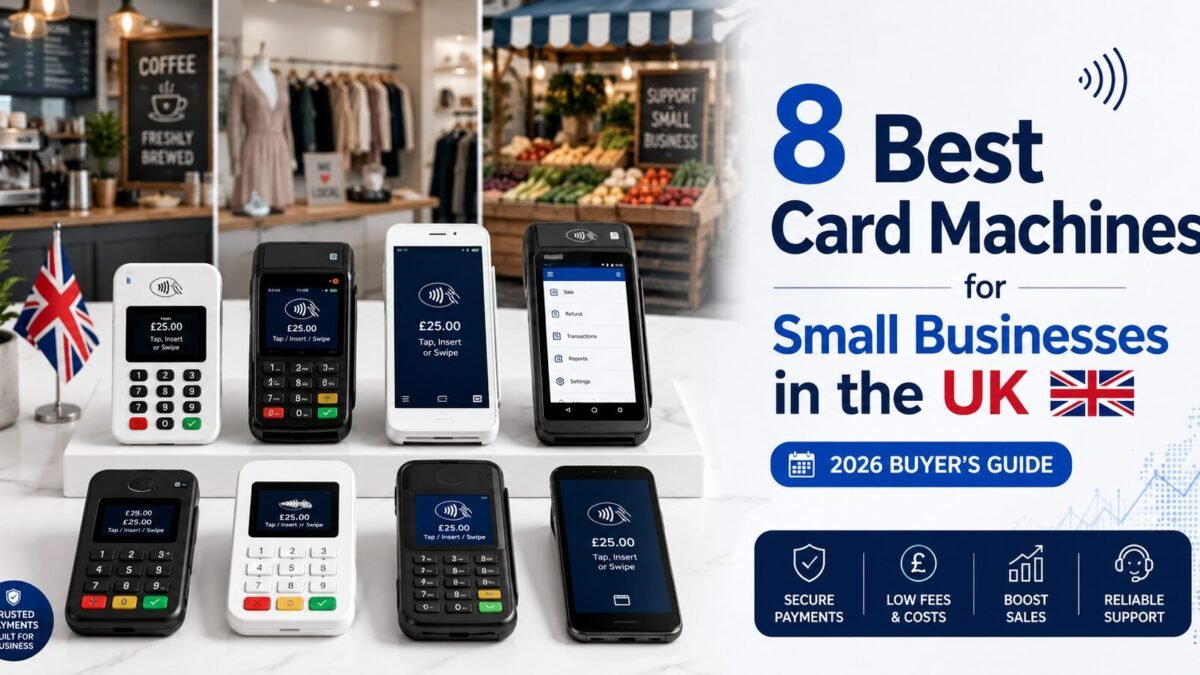
This guide compares the 8 best card machines for small businesses in the UK in 2026 — with up-to-date fees, hardware prices, payout speeds, and an honest verdict on who each one suits.
Quick Comparison: Card Machine Fees at a Glance (2026)
| Provider | Hardware Cost | In-Person Fee | Monthly Fee | Payout Speed |
| Paymentsave | From £15 + VAT (VERIFY) | Custom quote (VERIFY) | Quote-based | Fast settlement |
| Square Reader | £19 + VAT | 1.75% | None | Next working day |
| SumUp Solo Lite | £25 + VAT | 1.69% (0.99% on plan) | None (£19 optional plan) | Next day by 7am |
| PayPal POS Reader (ex-Zettle) | £29 | 1.75% | None | Minutes to PayPal balance |
| Tide Card Reader | From £99–£159 + VAT | 1.5% + 5p (0.89% + 3p on plan) | None (£17.99 optional plan) | 1–3 days (next-day boost £2.99/mo) |
| myPOS Go 2 | From £39 | From ~1.10% + 7p | None | Instant to myPOS account |
| Dojo Go | Rental (quote) | Custom, typically from ~1.2–1.4% | From ~£15/mo rental | Next business day by 10am |
| takepayments | Rental (quote) | From ~1.3% (quote) | Contract-based | Standard settlement |
The short version: if you just want the cheapest way to start, buy a Square Reader (£19) or SumUp Solo Lite (£25) today and pay a flat fee per sale. If you process more than roughly £3,000 a month in card payments, a monthly plan (SumUp Payments Plus, Tide’s plan) or a quote-based provider (Dojo, Paymentsave, takepayments) will usually work out cheaper. The detailed breakdowns below explain why.
1. Paymentsave — Best for Tailored Rates on Higher Volumes
Paymentsave is a UK payments provider offering mobile, portable, and countertop card machines with quote-based pricing. Unlike the fixed flat-rate apps below, Paymentsave tailors its transaction rates to your business turnover — which is exactly why it can undercut flat-rate providers once your card sales grow.
Pricing (2026):
| Element | Cost |
| Device cost | From £15 + VAT (VERIFY) |
| In-person transaction fee | Tailored quote based on turnover (VERIFY) |
| Keyed/CNP fee | ~2.75% (VERIFY) |
Pros:
- Transparent quotes with no hidden fees
- Supports chip & PIN, contactless, Apple Pay, Google Pay, Amex
- Digital receipts; staff performance and tip-splitting tools
- Fast access to funds
Cons:
- You need to request a quote rather than see a published rate, so it’s harder to compare instantly
Best for: Established small businesses taking £3,000+ a month in card payments who want a lower percentage rate than flat-fee readers can offer.
2. Square Reader — Best Cheap All-Rounder
The Square Reader (2nd generation) is the cheapest branded card reader you can buy in the UK at £19 + VAT, and it comes with arguably the best free software bundle of any provider: a full free POS app with inventory, staff accounts, sales analytics, invoicing, and online store tools at no monthly cost.
Pricing (2026):
| Element | Cost |
| Device cost | £19 + VAT (Terminal £149 + VAT) |
| In-person fee (UK cards) | 1.75% flat |
| Keyed-in fee | 2.5% |
| Online payments | 1.4% + 25p |
| Monthly fee | None on the free plan |
Pros:
- Lowest upfront cost in the UK
- Genuinely free POS software that rivals £30–£50/month systems
- Next-working-day settlement as standard; instant transfer available (1.5% fee)
- No contract
Cons:
- 1.75% is slightly higher than SumUp’s 1.69% for in-person sales
- Non-UK cards cost 3.25%, which matters if you serve tourists
Best for: New businesses and anyone who wants free, capable POS software with their reader — cafés, salons, and small shops especially.
3. SumUp Solo Lite — Lowest Flat Fee, No Strings
SumUp has retired the famous Air reader and replaced it with the Solo Lite (£25 + VAT), while the standalone Solo (£79 + VAT, built-in SIM, works without a phone) is its best-value device for busy sellers. SumUp’s headline strength is unchanged: the lowest standard flat rate of the big-name readers at 1.69%, with no monthly fees.
Pricing (2026):
| Element | Cost |
| Device cost | Solo Lite £25 + VAT; Solo £79 + VAT; Terminal ~£135 + VAT |
| In-person fee | 1.69% flat |
| Online payments | 2.5% |
| Payments Plus plan | £19/month → in-person fee drops to 0.99% |
Pros:
- Cheapest flat in-person rate of the big names
- Next-day payouts by 7am including weekends (to the free SumUp business account)
- Amex accepted at the same rate
- Payments Plus pays for itself above roughly £3,300/month in card turnover
Cons:
- Online rate (2.5%) is poor compared with Square
- Free POS tools are more basic than Square’s
Best for: Sole traders, market stalls, mobile hairdressers, tradespeople — anyone mostly taking in-person payments who wants the lowest flat fee with zero commitment.
4. PayPal POS Reader — Best If You Already Use PayPal (formerly Zettle)
Big change since our last update: Zettle by PayPal has been rebranded as PayPal POS. The hardware and app remain familiar to Zettle users, and the core deal is the same — a £29 reader, a 1.75% in-person rate, and no monthly fees. Its standout trick: funds land in your PayPal balance within minutes of a sale.
Pricing (2026):
| Element | Cost |
| Device cost | £29 (Terminal £149) |
| In-person fee | 1.75% |
| Manual/keyed entry | 3.4% + 20p |
| PayPal payment links | 2.9% + 30p |
Pros:
- Near-instant access to funds via PayPal
- Free POS app with product catalogue, barcodes and inventory
- Accepts Visa, Mastercard, Amex, Apple Pay, Google Pay
- No contract
Cons:
- Remote and keyed payments are expensive
- You’re tied into the PayPal ecosystem for fast payouts
Best for: Sellers who already run their business through PayPal — online sellers adding in-person sales, event traders, and anyone who values getting paid in minutes.
5. Tide Card Reader — Lowest Pay-As-You-Go Rate (If You Bank with Tide)
Tide’s card reader has quietly become one of the cheapest pay-as-you-go options in the UK at 1.5% + 5p — undercutting Square and SumUp on percentage. The catch: it only works with a Tide business bank account, and the hardware costs more upfront. Tide consolidated its plans in April 2026: the Sell In-Person plan (£17.99 + VAT/month) drops the rate to 0.89% + 3p with hardware from £99 + VAT.
Pricing (2026):
| Element | Cost |
| Device cost | Reader £159 + VAT (from £99 + VAT on plan); Reader Plus £199 + VAT |
| In-person fee (PAYG) | 1.5% + 5p |
| On Sell In-Person plan | 0.89% + 3p (£17.99 + VAT/month) |
| Settlement | 1–3 days (next-day boost £2.99 + VAT/month) |
Pros:
- Lowest PAYG percentage of the big names
- Takings settle straight into your Tide account with no transfer step
- Tap to Pay on iPhone available (1.5% + 11p) so you can start with no hardware at all
Cons:
- Requires a Tide business account
- Slower standard settlement than Square or SumUp
- Higher hardware cost; basic reporting
Best for: Businesses already banking with Tide, or new businesses happy to open a Tide account to get the lowest pay-as-you-go rate.
6. myPOS Go 2 — Best for Instant Access to Funds
The myPOS Go 2 (from £39) is a standalone terminal with its own SIM connectivity — no phone needed — and its killer feature is settlement: money from each sale is available in your free myPOS account instantly, 24/7. For businesses where cash flow is everything, that’s hard to beat.
Pricing (2026):
| Element | Cost |
| Device cost | From £39 |
| In-person fee | From ~1.10% + 7p (UK consumer cards; varies by card type) |
| Monthly fee | None |
Pros:
- Instant settlement to your myPOS account
- Built-in SIM works anywhere with signal
- Competitive headline rate
- Printer-equipped models available for receipts
Cons:
- Blended/variable pricing means business and international cards cost more than the headline rate
- Funds sit in a myPOS account rather than your main bank
Best for: Mobile businesses, food trucks, and traders who need takings available the moment the customer taps.
7. Dojo Go — Best for Busy Hospitality and Retail
Dojo has become one of the UK’s most popular providers for restaurants, pubs, and busy shops. It works differently from the buy-outright readers: you rent the terminal monthly and get a custom rate based on your turnover and card mix — typically landing somewhere from around 1.2–1.4% for small businesses, with bespoke rates for higher volumes. Settlement is reliably next business day by 10am.
Pricing (2026):
| Element | Cost |
| Device cost | Rental (no purchase option) — from ~£15/month, or quote-based |
| In-person fee | Custom quote; typically from ~1.2–1.4% for small businesses |
| Settlement | Next business day by 10am |
Pros:
- Fast, dependable payouts
- Superb 4G/WiFi terminals built for high-volume environments
- Strong POS integrations
- Rates improve as your turnover grows
Cons:
- No published pricing — you must go through a sales quote to compare
- Rental means you never own the hardware, which usually costs more than buying outright for low-volume sellers
Best for: Restaurants, bars, salons and shops processing serious daily volume that want bank-grade reliability and next-morning money.
8. takepayments — Best for Contract Flexibility on Custom Rates
takepayments offers portable, countertop, and mobile card machines on short, flexible contracts with rates quoted to your business — from roughly 1.3% for in-person transactions. It sits in the same quote-based category as Dojo and Paymentsave: less instant transparency, but potentially cheaper than flat-rate apps once your volume justifies it.
Pricing (2026):
| Element | Cost |
| Device cost | Rental/contract — quote based |
| In-person fee | From ~1.3% (quoted) |
| Keyed/CNP fee | Higher — confirm in quote |
Pros:
- Flexible contract lengths
- Full range of terminal types
- Fraud protection and real-time reporting
- Integrates with POS and accounting software
Cons:
- Quote-based pricing makes comparison harder
- Contracts and rental fees can outweigh savings for very small sellers
Best for: Growing businesses that have outgrown flat-rate readers and want a negotiated rate without a long lock-in.
How to Choose: PAYG Reader or Monthly Plan?
The single biggest pricing mistake small businesses make is comparing percentage rates without doing the break-even maths. Here’s the simple rule for 2026:
Under ~£3,000/month in card sales: buy a flat-rate reader outright (Square £19 or SumUp £25) and pay per transaction. No monthly fee means no wasted money in quiet months.
Over ~£3,000/month: a plan or quote will usually win. SumUp Payments Plus (£19/month for 0.99%) pays for itself at roughly £3,300/month of card turnover. Tide’s plan, Dojo, Paymentsave, and takepayments quotes all follow the same logic — a fixed monthly cost in exchange for a much lower percentage.
Worked example: at £5,000/month in card sales, SumUp PAYG (1.69%) costs £84.50/month in fees. On Payments Plus it’s £49.50 + £19 = £68.50 — saving nearly £200 a year. At £1,000/month, PAYG costs £16.90 while the plan costs £28.90 — PAYG wins easily.
Three more things to check before you commit: payout speed (myPOS and PayPal POS are near-instant; Square and SumUp next-day; Tide 1–3 days), where the money lands (Tide and myPOS pay into their own accounts), and card mix (if you serve tourists, check non-UK card surcharges — Square charges 3.25% for non-UK cards).
Frequently Asked Questions
What is the cheapest card machine for a small business in the UK?
The cheapest reader to buy is the Square Reader at £19 + VAT. The cheapest standard flat rate is SumUp at 1.69%, while Tide offers the lowest pay-as-you-go percentage at 1.5% + 5p if you hold a Tide business account.
Can I get a card machine with no monthly fees?
Yes. Square, SumUp, PayPal POS, Tide (PAYG), and myPOS all charge no monthly fee — you buy the reader once and pay a percentage per transaction only.
Do I need a business bank account for a card reader?
For most providers (Square, SumUp, PayPal POS, Dojo) any UK bank account works. Tide is the exception — its reader only settles into a Tide business account.
Can I accept card payments with just my phone?
Yes. Tap to Pay lets compatible iPhones and Android phones accept contactless payments with no reader at all — SumUp, Square, PayPal POS and Tide all offer it in the UK. It’s a good way to test card acceptance before buying hardware.
How much are card machine fees in the UK in 2026?
For small businesses on flat-rate readers, expect 1.5%–1.75% per in-person transaction with no monthly fee. Businesses on monthly plans or negotiated contracts typically pay 0.79%–1.4% plus a fixed monthly cost.
Are card machines worth it for a very small business?
Almost always. With cash now under 10% of UK payments and readers costing from £19 with no ongoing fees, the cost of accepting cards is far smaller than the sales lost by refusing them.
Conclusion
For most UK small businesses starting out in 2026, the decision comes down to this: Square Reader (£19) if you want the best free software with your reader, or SumUp Solo Lite (£25) if you want the lowest flat fee. PayPal POS wins if you live in the PayPal ecosystem, Tide if you bank with Tide, and myPOS if instant access to your money matters most.
Once your card turnover passes roughly £3,000 a month, stop paying flat rates — get quotes from Paymentsave, Dojo, and takepayments, and compare them against SumUp’s Payments Plus plan. A difference of half a percent on £5,000 a month is £300 a year back in your pocket.
Whichever you choose, the worst option in 2026 is having no card machine at all.