

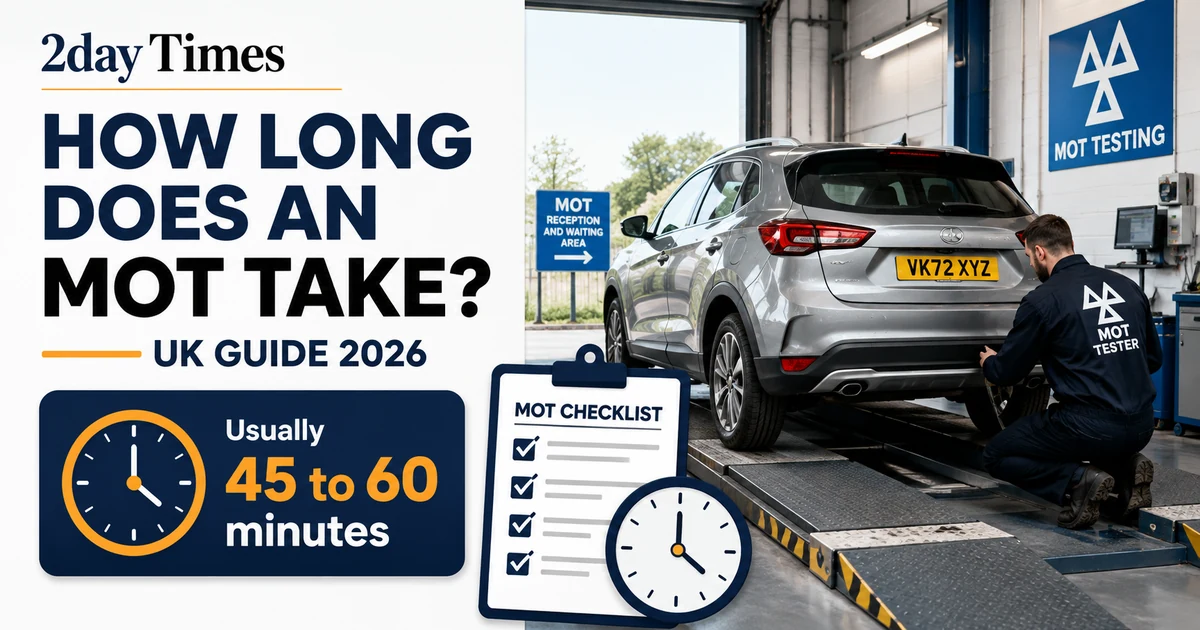
If your MOT is due, you may be wondering how much time to leave in your day. The test itself is fairly quick, but your total time without the car can be much longer.
For most cars, an MOT test usually takes around 45 to 60 minutes. However, that does not necessarily mean you will get your vehicle back within an hour. Garage workload, repairs, paperwork and a retest after a failure can all increase the total time.
Halfords and Kwik Fit currently both give approximately 45 minutes to 1 hour as the normal test duration, while MoneyHelper gives the same general range.
Here is what actually happens during that time and when you should allow longer.
How Long Does an MOT Test Take?
A standard car MOT normally takes 45 to 60 minutes once the tester begins the inspection.
The tester works through a defined series of road safety and environmental checks rather than performing a general mechanical service.
The MOT checks whether important parts of the vehicle meet the required legal standards at the time of the test. GOV.UK confirms that an MOT does not assess the general condition of the engine, clutch or gearbox.
You can read the official GOV.UK MOT guidance for details of how the test works.
Why Might Your Car Be at the Garage for Longer?
The 45 to 60 minute estimate refers to the inspection itself.
Your appointment can take longer for several reasons.
The Garage Is Busy
Some garages operate appointments where your car goes directly into the MOT bay.
Others ask you to drop the car off in the morning and collect it later. Your car might therefore remain at the garage for several hours even though the actual test takes less than an hour.
If timing matters, ask when booking whether the appointment is a specific test slot or a drop-off arrangement.
Your Car Fails
Finding a defect does not necessarily make the original inspection dramatically longer because the tester still needs to complete the required test.
What adds time is repairing the problem afterwards.
A failed bulb or another simple issue may be dealt with relatively quickly. More serious problems involving brakes, suspension, tyres or emissions can take much longer.
If repairs are required, the garage should explain what work is needed and how long it expects that work to take.
What Happens During Those 45 to 60 Minutes?
An MOT covers a surprisingly large number of vehicle components.
Depending on the vehicle, checks can include:
- Brakes
- Steering
- Suspension
- Tyres and wheels
- Lights and electrical equipment
- Seat belts and seats
- Windscreen, wipers and washers
- Mirrors
- Registration plates
- Exhaust and emissions
- Fuel system
- Vehicle structure
- Horn
- Doors
- Vehicle identification
GOV.UK’s inspection information confirms that brakes, tyre condition and tread, registration plates, lights and numerous other safety items form part of the test.
This explains why a proper MOT cannot simply be rushed through in a few minutes.
How Long Does an MOT Take if the Car Fails?
The original MOT itself will normally still be around the usual duration.
What happens next depends entirely on the defects.
An MOT failure occurs when the test identifies a major or dangerous defect. Minor defects do not automatically cause a failure, although they should still be addressed.
A simple repair might add less than an hour. More complicated work could mean leaving the vehicle at the garage for the rest of the day or longer.
You should therefore avoid booking an MOT immediately before a journey where you absolutely need the car.
How Long Does an MOT Retest Take?
A partial retest is normally shorter than repeating the complete MOT because the tester focuses on items that failed and anything affected by the repairs.
The exact time depends on what needs checking.
In Great Britain, GOV.UK says a vehicle left at the same test centre for repair can receive a free partial retest if it is retested within 10 working days. Different rules apply if you take the vehicle away for repairs.
Do not assume every retest is automatically free. The timing, repair arrangement and failed items can affect whether a fee applies.
Can You Wait While an MOT Is Being Done?
Often, yes.
Many MOT centres have customer waiting areas and allow drivers to stay while the vehicle is tested.
If the garage offers a proper while-you-wait appointment and the car passes, you could be finished in roughly an hour.
However, ask before booking.
Some garages schedule several vehicles and prefer customers to leave their cars for part of the day.
If you need to remain mobile, confirm the arrangement rather than assuming the advertised MOT appointment time is the exact moment your test will start.
How Long Does an MOT and Service Take Together?
An MOT and a car service are different jobs.
The MOT checks whether your car meets minimum legal road safety and environmental standards. A service is preventative maintenance and can involve changing oil, filters, fluids and other components depending on the service level.
RAC currently estimates that an interim service can take roughly 45 to 75 minutes and a full service up to around 90 minutes, while an MOT itself takes around 45 to 60 minutes.
If you book both together, allow several hours rather than simply adding the two minimum times.
Garages may need extra time for inspections, servicing tasks, parts or repairs discovered during either process.
Can an MOT Be Done Faster on an Electric Car?
Do not assume an electric vehicle will have a dramatically shorter test simply because it has no conventional exhaust emissions test.
Kwik Fit currently states that an EV MOT still takes approximately 45 minutes to an hour.
Electric vehicles have different components, but the tester still needs to inspect the applicable safety items thoroughly.
When Should You Book Your MOT?
Leaving your MOT until the expiry date creates unnecessary risk.
In Great Britain, you can normally have an MOT up to one month minus one day before the existing certificate expires and keep the same renewal date for the following year.
That means you can create a useful buffer in case the vehicle fails and needs repairs.
Booking early is especially sensible if:
- You rely on the car every day
- Your garage is busy
- The vehicle has known problems
- You are planning a long journey
- Your current MOT is close to expiry
Do not confuse an MOT certificate with a guarantee that a car remains safe for the whole year. Drivers are responsible for keeping their vehicles roadworthy at all times.
Great Britain and Northern Ireland Have Different MOT Systems
One detail many general guides overlook is that MOT arrangements are not identical across the whole UK.
The guidance above about garage MOTs and Great Britain retest rules applies mainly to England, Scotland and Wales.
Northern Ireland operates vehicle testing through the Driver and Vehicle Agency at dedicated test centres, and some eligibility, booking and retest rules differ.
For example, nidirect currently states that cars and motorcycles in Northern Ireland are generally tested from four years old, rather than applying the same first-test rule used for most cars in Great Britain.
Northern Ireland drivers should therefore follow current DVA guidance for their vehicle rather than assuming every Great Britain rule applies.
How to Reduce the Chance of MOT Delays
You cannot guarantee a pass, but a few simple checks can prevent avoidable problems.
Before the appointment:
Check that your headlights, brake lights and indicators work.
Look at the tyres for damage and make sure the tread is legal.
Make sure your windscreen washer works and contains fluid.
Check the wipers.
Make sure mirrors are secure.
Check that registration plates are visible and secure.
Remove unnecessary clutter that could interfere with the inspection.
If you drive a modified or adapted vehicle, requirements can sometimes be more specialised. Our guide to Discovering the Possibilities with Adapted Vehicles provides additional reading about adapted transport.
You can also browse the 2DayTimes Blog section for more practical guides, or visit 2DayTimes for the latest articles.
Frequently Asked Questions
How long does an MOT take on average?
A normal car MOT generally takes around 45 to 60 minutes. Your total time at the garage may be longer because of scheduling, repairs or retesting.
Is 30 minutes enough for an MOT?
A full standard car MOT is more commonly quoted at around 45 to 60 minutes. You should not plan around a 30 minute turnaround unless your test centre specifically advises you otherwise.
Can an MOT take two hours?
The inspection itself usually does not, but your total garage visit can easily reach two hours or more if there are delays, repairs or additional work.
How long does an MOT take if the car passes?
If there are no delays, around 45 to 60 minutes is typical for the test. Paperwork and garage scheduling can add extra time.
How long does an MOT take if the car fails?
The actual inspection may still take roughly the normal amount of time. Repairs and a retest can extend the process by hours or even longer depending on the faults.
Can I stay and watch my MOT?
In Great Britain, GOV.UK says you can watch the MOT from a designated viewing area, but you cannot interrupt the tester.
Does an MOT check the engine?
Not as a general mechanical inspection. GOV.UK states that an MOT does not cover the condition of the engine, clutch or gearbox.
Final Thoughts
So, how long does an MOT take?
For most standard cars, expect the actual test to take approximately 45 to 60 minutes.
However, it is safer to allow more time in your schedule. Garage workload, repairs, a failed test or a retest can turn a one-hour inspection into several hours without your car.
If your MOT is approaching, book early, carry out a few basic checks beforehand and ask the garage whether you can wait or need to leave the vehicle.
The test may take less than an hour, but planning a little extra time can make MOT day much easier.