

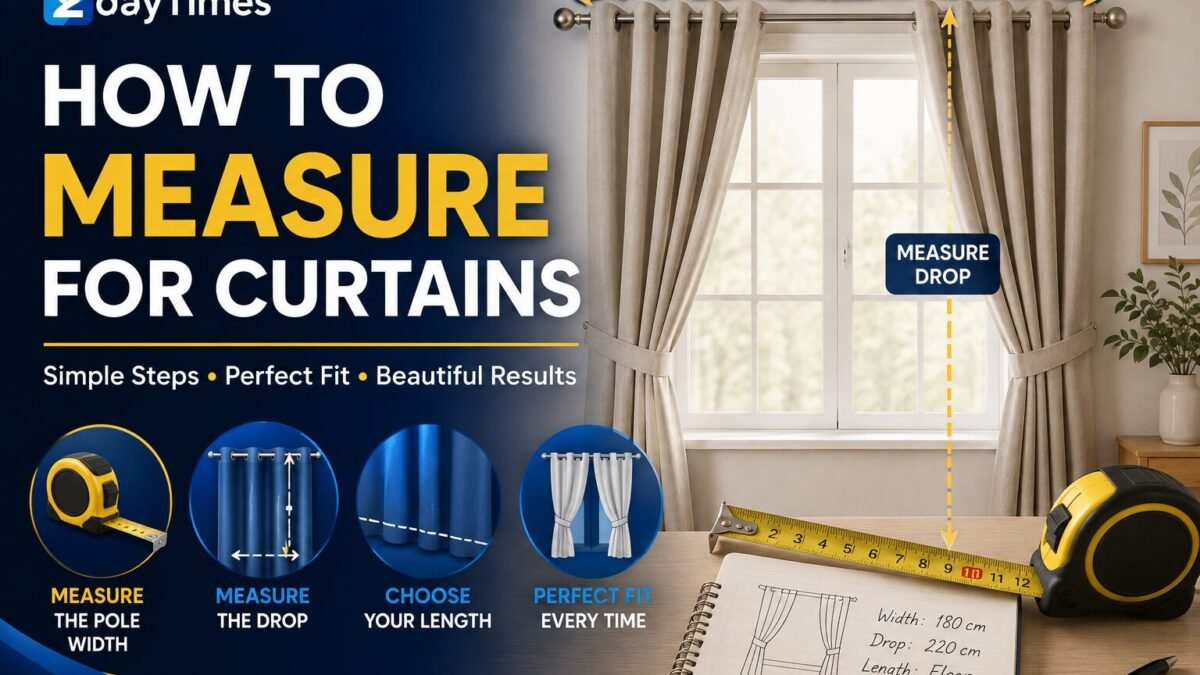
Buying new curtains should be simple, but one wrong measurement can leave you with panels that barely meet in the middle, drag across the floor or stop awkwardly above the skirting board.
The good news is that learning how to measure for curtains is straightforward once you know exactly what should be measured.
For most curtains, measure the full width of the fitted curtain pole or track, not just the window itself. Then measure the drop from the correct starting point for your curtain heading to where you want the curtain to finish.
A steel tape measure, a few careful checks and five minutes of preparation can save you from an expensive sizing mistake.
What You Need Before Measuring
You do not need specialist equipment.
Have these ready:
- A steel tape measure
- Pencil and paper or your phone
- A step ladder if the pole is high
- Your chosen curtain heading, if already decided
A steel tape is preferable to a soft fabric measuring tape because it stays straight and is easier to measure accurately over a large window.
Dunelm’s current how to measure for curtains guide also recommends using a steel tape measure and measuring after the pole or track has been fitted where possible.
Before ordering anything, write each measurement down immediately. Do not rely on memory when measuring several windows.
Step 1: Measure the Curtain Width
This is where one of the most common mistakes happens.
You normally need to measure the curtain pole or track, rather than simply taking the width of the glass or window frame.
If You Have a Curtain Pole
Measure from one end of the usable pole to the other.
Do not include the decorative pieces at the ends, known as finials.
For example, if the usable pole measures 180 cm, record the curtain width measurement as 180 cm.
If You Have a Curtain Track
Measure the complete usable length of the track.
If your track overlaps in the centre, follow the manufacturer’s measuring instructions because the overlap may need to be included.
Dunelm’s current guidance similarly tells customers to measure the full pole or track width while excluding decorative finials.
What If You Have Not Installed a Pole Yet?
Ideally, install the pole or track before ordering curtains.
This removes much of the guesswork because you are measuring the actual hardware the curtains will hang from.
If that is not possible, measure the window width and plan enough additional width on both sides for the curtain pole.
Dunelm currently suggests adding a total of 40 cm to the window width when no pole has yet been fitted, which provides roughly 20 cm on either side.
John Lewis also advises allowing at least 15 cm beyond each side of the window when positioning a curtain track.
The exact extension can vary according to your wall space, curtain thickness and style, so check the instructions for the pole or track you plan to buy.
Extending the pole past the window also allows more of the curtain fabric to sit beside the glass when open, helping maximise daylight.
Step 2: Decide Where the Curtains Should Finish
Before measuring the drop, decide what finished look you want.
There are several common choices.
Windowsill Length
A short curtain can finish just above the sill.
Dunelm suggests around 1 cm above the windowsill for this style.
This can work well where furniture or a radiator makes longer curtains impractical.
Below the Sill
Another option is for the curtain to continue below the windowsill.
Around 15 cm below the sill is one common reference point, although you should check what is below the window before choosing the final length.
Floor Length
Floor length curtains provide a clean, modern finish in living rooms and bedrooms.
Rather than allowing the fabric to drag, you can measure so the curtain finishes slightly above the floor.
Dunelm’s guide uses approximately 1 cm above the floor as its floor length recommendation.
Puddle Length
For a more dramatic look, some curtains intentionally extend onto the floor.
Dunelm describes puddle curtains as extending roughly 2 to 7 cm beyond floor level.
This can look luxurious but requires more maintenance because the fabric rests on the floor.
Step 3: Measure the Curtain Drop
Now measure vertically from the correct starting point to your chosen finishing point.
The starting point depends on the heading.
How to Measure for Eyelet Curtains
Eyelet curtains have large metal rings built into the curtain header, and the pole passes directly through them.
For eyelet curtains, measure the drop from the top of the curtain pole down to the point where you want the curtain to finish.
Dunelm currently uses this measuring method for its eyelet curtains.
Remember that a small section of fabric usually sits above the pole when eyelet curtains are hung. Product designs vary, so always check the retailer’s size guide before ordering.
How to Measure for Pencil Pleat Curtains
Pencil pleat curtains can hang from a pole using curtain rings or from a track.
If using a pole with rings, measure from the eye of the curtain ring down to your chosen finishing point.
If using a track, measure from the top of the track according to the curtain supplier’s instructions.
Dunelm specifies measuring pencil pleats from the eye of the curtain ring, or from the top of the track.
This small difference between eyelets and pencil pleats is exactly why you should choose your heading before finalising the drop.
How Wide Should Curtains Be?
Your pole measurement and the actual amount of curtain fabric are not necessarily the same thing.
Curtains need extra fabric so they form folds when closed. This is called fullness or gather.
A pair that has almost exactly the same total fabric width as the pole may look stretched and flat when closed.
However, fullness rules vary by fabric and heading.
For example, Dunelm’s current ready-made guidance says each individual panel in its pairs should equal the width of the pole for a full appearance. That effectively provides substantial combined fabric width across the pair.
Do not automatically multiply measurements when ordering. Check how the specific retailer labels its sizes, because some dimensions refer to each curtain while others may describe a pair.
A Simple Curtain Measuring Example
Imagine your fitted pole measures 180 cm, excluding the finials.
You want eyelet curtains finishing around 1 cm above the floor.
Measure from the top of the pole to approximately 1 cm above the floor.
Suppose that measurement is 225 cm.
Your key measurements are therefore:
Pole width: 180 cm
Required drop: approximately 225 cm
You can then compare those figures with the retailer’s available sizes and fullness recommendations.
If the exact drop is unavailable in ready-made curtains, choose carefully rather than assuming the nearest size will look right. Made-to-measure curtains or professional alterations may be better for unusual windows.
What About a Radiator Under the Window?
A radiator can affect your curtain length decision.
Long curtains hanging directly over a working radiator can interfere with how heat moves into the room.
In that situation, sill length or below-sill curtains may be more practical than floor length ones.
You should also check the distance between the curtain and radiator so the fabric is safely positioned.
Every room is different, which is why choosing the final curtain position before measuring is so important.
For another practical window-related guide, see our article on how to reduce condensation on windows. The article is also published in the same Lifestyle section.
Common Curtain Measuring Mistakes
Measuring Only the Window
If a pole or track is already fitted, use that as your main width reference rather than the glass itself.
Including the Finials
Decorative ends are not part of the usable curtain pole, so including them can give you an incorrect width.
Measuring Before Choosing the Heading
Eyelet and pencil pleat curtains do not necessarily use the same starting point for the drop.
Choose the heading first.
Using a Fabric Tape
A flexible tape can sag or stretch over a large window. A steel tape provides a more reliable straight measurement.
Measuring Only Once
Check important measurements at least twice before placing an order.
For floor length curtains, it can also be helpful to check the drop at more than one point because floors and poles are not always perfectly level.
Assuming Every Retailer Sizes Curtains the Same Way
One retailer may state the width of each individual panel while another product may use different packaging terminology.
Always read the specific product size description.
Ready-Made or Made-to-Measure Curtains?
Ready-made curtains are usually easier and more affordable when your measurements fit standard sizes.
Made-to-measure curtains become useful when you have an unusually wide or tall window, a bay window, an awkward pole or a specific finished length that standard sizes cannot provide.
If you are paying for made-to-measure curtains, double checking your figures becomes even more important because customised products may have different return conditions.
You can find more home and everyday advice in the 2DayTimes Lifestyle section or browse the latest guides on 2DayTimes.
Frequently Asked Questions
Do I measure the window or curtain pole?
If your pole or track is already fitted, measure its usable width rather than simply measuring the window. Exclude decorative finials from a curtain pole.
How far should curtains be from the floor?
For a clean floor length finish, around 1 cm above the floor is a useful starting point. Puddle curtains intentionally extend onto the floor instead.
How do I measure curtains if I do not have a pole?
Measure the window width and allow additional space on each side for the future pole. Dunelm currently suggests adding 40 cm in total when no pole is fitted.
Where do I measure eyelet curtains from?
Measure from the top of the curtain pole down to your intended finishing point.
Where do I measure pencil pleat curtains from?
For a pole, measure from the eye of the curtain ring. For a track, follow the supplier’s track measurement instructions.
Should curtains touch the floor?
They can, but they do not have to. Curtains finishing slightly above the floor create a neat appearance, while puddle curtains intentionally use extra length for a more dramatic effect.
Final Thoughts
Knowing how to measure for curtains comes down to three decisions: measure the correct width, choose the curtain heading and decide exactly where you want the fabric to finish.
Where possible, fit the pole or track first. Measure its usable width carefully, then take the drop from the correct point for your chosen heading.
Use a steel tape, write every measurement down and check everything twice before ordering.
A few extra minutes with a tape measure are far easier than discovering that a new pair of curtains is too short, too narrow or completely wrong for the window.