
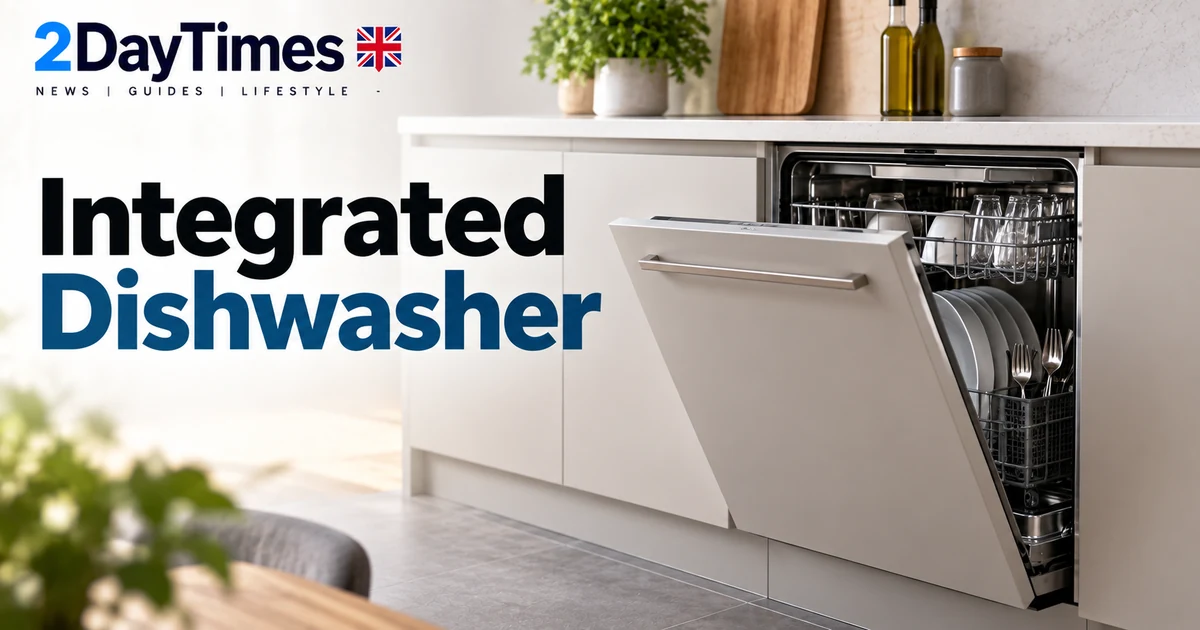
An integrated dishwasher is designed to sit inside your kitchen cabinetry with a furniture door fitted to the front, helping the appliance blend into the rest of the room.
For many UK kitchens, it is a cleaner-looking alternative to a freestanding dishwasher. But choosing the right one involves more than checking whether the appliance is 60cm wide.
You also need to consider whether you want a fully integrated or semi-integrated model, the size of the cabinet opening, place-setting capacity, noise level, energy use, basket layout and how the furniture door attaches to the appliance.
For most households with enough space, a full-size 60cm integrated dishwasher is the most practical starting point. Smaller kitchens may benefit from a 45cm slimline model.
What Is an Integrated Dishwasher?
An integrated dishwasher is installed underneath the kitchen worktop and hidden behind a cabinet door that matches the surrounding units.
Unlike a freestanding dishwasher, the appliance is not designed to be visually exposed.
This creates a more consistent fitted-kitchen appearance.
The main dishwasher itself still performs the same basic job as a freestanding model. The important difference is how it is installed and how the controls are presented.
Bosch’s current dishwasher guidance explains that integrated and freestanding models can offer very similar functions, so choosing between them is largely about installation, space and appearance.
Fully Integrated vs Semi-Integrated Dishwasher
There are two common integrated designs.
Fully Integrated Dishwasher
A fully integrated dishwasher is almost completely hidden when the door is closed.
The controls are normally positioned along the top edge of the dishwasher door.
Once the matching kitchen panel is fitted, the appliance blends into the cabinetry.
This is usually the best choice if appearance is the priority.
The downside is that you cannot always see the control panel while the machine is running.
Some models solve this with a floor light, projected status indicator or audible signal.
Semi-Integrated Dishwasher
A semi-integrated model also sits behind kitchen cabinetry, but part of the appliance control panel remains visible.
This means you can see and operate the controls without opening the door.
It does not look quite as seamless as a fully integrated machine, but some people prefer the easier access to the display.
What Size Integrated Dishwasher Do You Need?
The two most common UK widths are:
Full-size: approximately 60cm wide
Slimline: approximately 45cm wide
Bosch currently sells both 60cm and 45cm fully integrated models in the UK.
Do not assume that every 60cm dishwasher has identical overall dimensions.
Height, depth, door arrangement and installation clearance can vary.
Before buying, measure:
- Cabinet opening width
- Cabinet opening height
- Available depth
- Space for hoses
- Furniture door dimensions
- Clearance when the dishwasher door opens
Always compare those measurements with the installation drawing for the exact model.
Is a 60cm Integrated Dishwasher Better?
Not automatically, but it usually provides more capacity.
A full-size dishwasher makes sense when you:
- Have a family
- Cook regularly
- Use several plates, pans and glasses each day
- Want to run fewer loads
- Have enough kitchen space
A slimline 45cm dishwasher can be a better fit for:
- Smaller kitchens
- Flats
- Couples
- Smaller households
- Homes where cabinet space is limited
Choosing a dishwasher that matches your household is more useful than simply buying the largest model available.
What Does Place Setting Capacity Mean?
Dishwasher capacity is commonly described using place settings.
A standard place setting represents a group of typical crockery, glassware and cutlery for one person.
Bosch describes a standard place setting as ten items, including items such as a dinner plate, dessert plate, drinking glass, cup, saucer and cutlery.
Full-size dishwashers commonly hold around 12 to 15 place settings.
Capacity does not tell you everything, though.
Two machines with the same stated place-setting capacity may have very different rack layouts.
Look at:
- Adjustable upper baskets
- Folding plate supports
- Cutlery baskets
- Cutlery drawers
- Tall glass clearance
- Space for pans
A well-designed interior can sometimes matter more than one extra place setting.
Should You Choose a Cutlery Drawer or Basket?
Traditional dishwashers often use a removable cutlery basket in the lower rack.
Newer machines may have a separate shallow drawer at the top.
Cutlery Basket
Advantages:
- Simple to load
- Easy to remove
- Familiar design
Disadvantage:
It occupies some space in the lower basket.
Cutlery Drawer
Advantages:
- Frees up lower-rack space
- Separates cutlery
- Can hold smaller utensils
Disadvantage:
It may slightly reduce vertical space available in the upper rack.
There is no universal winner.
Think about the dishes and pans you actually use.
How Quiet Should an Integrated Dishwasher Be?
Noise matters more than many buyers expect.
This is especially important in:
- Open-plan kitchens
- Kitchen-diners
- Flats
- Homes where you run the dishwasher at night
Dishwasher noise is measured in decibels, or dB.
Bosch’s current buying guidance describes machines around 40 to 45 dB as particularly quiet.
A few decibels may not look like a big difference on a specification sheet, but quieter operation can matter in an open living space.
Check the dishwasher’s official energy label, which includes its noise figure and noise class.
Understanding Dishwasher Energy Labels
UK dishwasher energy labels provide more information than just an efficiency letter.
Useful figures include:
- Energy efficiency class
- Energy used per 100 Eco cycles
- Water consumption per Eco cycle
- Number of place settings
- Eco programme duration
- Noise level
- Noise class
The energy rating is based on the Eco programme.
Do not judge a machine only by one figure.
For example, a larger dishwasher may use more energy in one cycle but could still be efficient if you regularly fill it properly instead of running several smaller loads.
The official Bosch dishwasher buying guide provides more detail on dishwasher sizing, capacity and noise.
Which Dishwasher Programmes Actually Matter?
Modern integrated dishwashers can have long programme lists, but most households repeatedly use only a few.
Useful programmes can include:
Eco
Designed to minimise energy and water use for normally soiled dishes.
It often takes longer than a standard programme.
That is normal.
Auto
Uses sensors to adjust parts of the wash according to the load.
Intensive
Useful for heavily soiled pots, pans and plates.
Quick or Express
Designed for lightly soiled items when you need them sooner.
Glass
Uses gentler settings for delicate glassware.
You do not necessarily need a dishwasher with the largest possible number of programmes.
Choose features that match how you actually cook and wash dishes.
Do You Need a Smart Integrated Dishwasher?
Some modern dishwashers offer Wi-Fi connectivity.
Depending on the brand, an app may allow you to:
- Start or monitor programmes
- Receive notifications
- Download additional programmes
- Check maintenance information
- Control selected functions remotely
Smart features are convenient, but they should not be your first buying criterion.
Capacity, cleaning ability, rack design, noise and reliability are generally more important.
Check the Door Hinge System Before Buying
This is a detail that is easy to miss.
The furniture door attached to an integrated dishwasher needs to move correctly when the appliance opens.
Different kitchens and dishwasher models can use different hinge arrangements.
You may see terms such as:
- Fixed hinge
- Sliding hinge
- Variable hinge
A sliding or variable hinge system can be useful where the furniture door needs to move upward slightly as the dishwasher opens, particularly with certain plinth heights or modern kitchen layouts.
Do not assume your existing furniture door will automatically fit a replacement dishwasher.
Check the installation diagram or ask your kitchen fitter before ordering.
Is an Integrated Dishwasher Difficult to Install?
Installation can be more involved than installing a freestanding dishwasher because the appliance must align with the cabinetry and the furniture door must be fitted correctly.
You need:
- Suitable water connection
- Waste connection
- Electrical supply
- Correct cabinet opening
- Suitable hose routing
- Correct furniture door installation
- Proper levelling
Bosch recommends considering professional installation where appropriate to ensure the machine is set up to the manufacturer’s specification.
Professional fitting is especially worth considering if you are replacing a machine with a different hinge or door system.
Integrated vs Freestanding Dishwasher
An integrated dishwasher is usually better when:
- You want a seamless kitchen
- Matching cabinetry matters
- You are designing a fitted kitchen
- The appliance will remain in place long term
A freestanding dishwasher may be better when:
- You want simpler installation
- You may move home
- You want easier access to the appliance
- You do not want to fit a furniture door
Cleaning performance is not automatically better just because a dishwasher is integrated.
Compare individual models.
What Should You Check Before Buying?
Use this simple checklist:
Measure the Cabinet
Check width, height and depth.
Decide Between 45cm and 60cm
Choose based on available space and household size.
Check Place Settings
Make sure capacity suits your normal washing load.
Compare Rack Layouts
Look at how your plates, pans and glasses will actually fit.
Check Noise
This is particularly important for open-plan kitchens.
Read the Energy Label
Compare water and energy consumption, not just the headline rating.
Check the Hinge System
Make sure the furniture door and kitchen plinth are compatible.
Compare Programmes
Do not pay extra for features you will rarely use.
Common Integrated Dishwasher Mistakes
Buying by Width Alone
Two nominally 60cm machines can still have different installation requirements.
Forgetting About the Furniture Door
The dishwasher is only part of an integrated installation.
Your existing door panel needs to work with the new machine.
Ignoring Noise Levels
A louder dishwasher can become frustrating in an open-plan home.
Buying Too Small
Running a small dishwasher twice every evening defeats much of the convenience.
Buying Too Large
A large dishwasher that is constantly half empty may not suit a small household.
Ignoring Internal Layout
Capacity figures do not tell you whether your large dinner plates and pans will fit comfortably.
More Home Appliance Guides
If you are comparing other household appliances, our Hotpoint Washing Machine guide explains washing machine capacities, programmes and energy considerations.
You can also browse more practical home content in the 2DayTimes Lifestyle section or visit the 2DayTimes homepage.
Frequently Asked Questions
What is an integrated dishwasher?
An integrated dishwasher sits inside fitted kitchen cabinetry and has a matching furniture panel attached to its door.
What is the standard width of an integrated dishwasher?
Full-size integrated dishwashers are generally around 60cm wide. Slimline models are generally around 45cm wide.
What is the difference between fully integrated and semi-integrated?
A fully integrated dishwasher hides the controls when the door is closed. A semi-integrated model leaves the control panel visible.
Can any cupboard become an integrated dishwasher space?
Not automatically. The opening must have the correct dimensions, plumbing, drainage, power supply and door arrangement for the appliance.
Are integrated dishwashers quieter?
Being fitted behind a furniture door can help make them feel discreet, but actual noise varies by model. Check the official dB rating.
Is a slimline integrated dishwasher good for two people?
It can be. A 45cm dishwasher may provide enough capacity for smaller households while using less cabinet width.
How many place settings should I choose?
Full-size machines commonly offer around 12 to 15 place settings. Your ideal capacity depends on household size and how often you cook.
Final Thoughts
An integrated dishwasher is a strong choice when you want the convenience of automatic dishwashing without interrupting the appearance of a fitted kitchen.
For most households, a 60cm full-size model offers the most practical capacity. A 45cm slimline dishwasher is better where kitchen space is limited.
Before buying, measure carefully and look beyond headline features.
Check the cabinet opening, place-setting capacity, basket layout, noise level, energy label, furniture door system and the programmes you will genuinely use.
The best integrated dishwasher is not necessarily the model with the most technology.
It is the one that fits your kitchen properly, handles your normal dishes comfortably and works quietly and efficiently for the way your household actually lives.