
If you live in a hard water area of the UK, you have almost certainly seen it — that chalky white crust clinging to the bottom of your kettle and those tiny flakes floating in your morning cuppa. Learning how to remove limescale from a kettle properly is one of those small kitchen skills that saves you money, protects your appliance, and gives you better-tasting tea and coffee.
The good news? You do not need expensive gadgets or harsh chemicals. With one or two ingredients already in your cupboard, you can have a sparkling, scale-free kettle in under an hour. This guide walks you through every method that actually works, the one common “hack” that does not work, and how to stop limescale coming back for good.
What Is Limescale and Why Does It Build Up?
Limescale is a hard, chalky deposit made mostly of calcium carbonate. It forms when hard water — water rich in dissolved calcium and magnesium — is heated. As the water boils and evaporates, the minerals are left behind and slowly harden onto the heating element and base of your kettle.
Roughly 60% of the UK lives in a hard or very hard water area, with the South East, East Anglia and parts of the Midlands being the worst affected. That is why a kettle in London or Cambridge scales up far faster than one in Glasgow or Cardiff. You can check your local water hardness on your water supplier’s website in about thirty seconds.
Left alone, limescale does more than look unpleasant. It forces your kettle to work harder and use more electricity, shortens the life of the heating element, and can leave a slightly bitter, cloudy taste in hot drinks. Removing it regularly is genuinely worth the five minutes it takes.
The Fastest Way to Remove Limescale From a Kettle
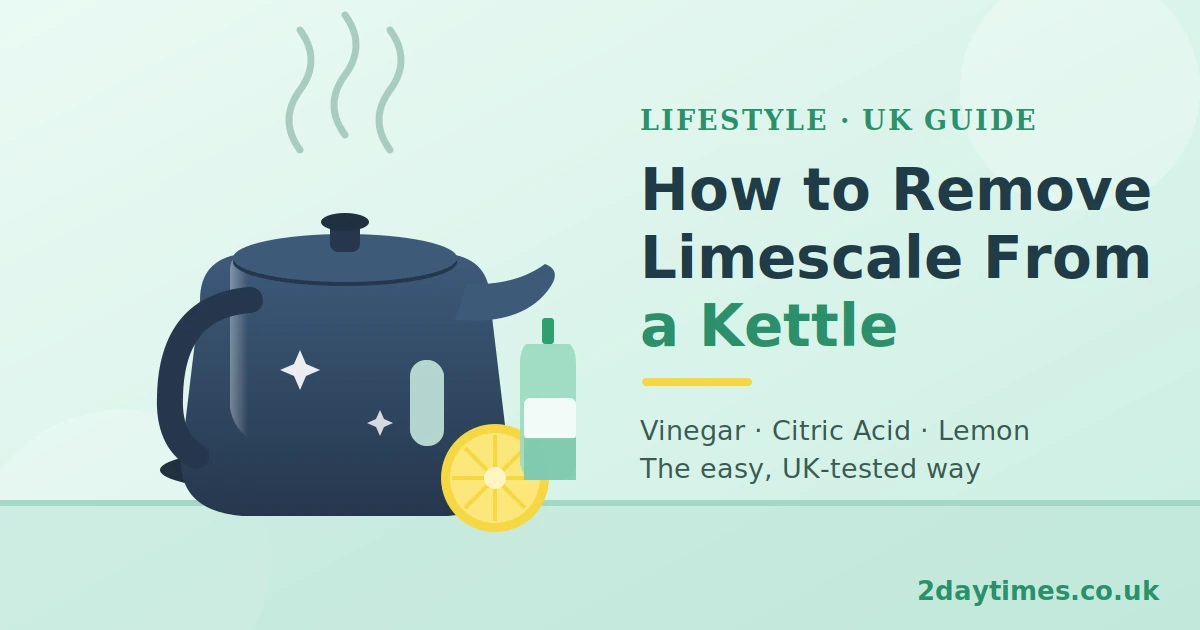
Here is the quick answer for anyone in a hurry. To descale a kettle, fill it with an equal mix of water and white vinegar (or two tablespoons of citric acid dissolved in water), boil it, then leave it to sit for 30–60 minutes before rinsing thoroughly. The acid dissolves the calcium carbonate and the scale wipes away easily.
Now let us look at each method in detail so you can pick the one that suits you.
Method 1: White Vinegar (Cheapest and Most Reliable)
White vinegar is the classic British descaling trick, and it works because its acetic acid breaks down calcium deposits.
- Fill the kettle halfway with a 50:50 mix of white vinegar and water, making sure the solution covers all the visible scale.
- Bring it to the boil, then switch the kettle off.
- Leave the mixture to stand for 30 minutes to 1 hour (overnight for very stubborn scale).
- Pour the solution away and gently wipe any loose flakes with a soft cloth or non-abrasive sponge.
- Refill with fresh water, boil, and discard at least twice to remove any lingering vinegar smell.
This method costs pennies and is ideal for most kettles.
Method 2: Citric Acid (Fast, Odour-Free and Food Safe)
If you dislike the smell of vinegar, citric acid is the better choice. It is a natural acid derived from citrus fruit, sold cheaply in UK supermarkets, chemists and baking aisles.
- Fill the kettle with water to just above the scale line and bring it to the boil.
- Switch off, then stir in 1–2 heaped tablespoons of citric acid powder (add it carefully as it can fizz).
- Leave for 15–20 minutes. You will often see the scale lift off on its own.
- Pour away, rinse well, and boil a fresh kettle of water once before use.
Citric acid is faster than vinegar, leaves no aftertaste, and is kinder to the environment than harsh commercial products.
Method 3: Lemon Juice (Natural and Pleasant Smelling)
Lemon works on the same principle as citric acid because it is naturally acidic. Slice one lemon, drop the slices into the kettle, fill with enough water to cover the scale, and boil. Let it sit for around an hour, then rinse. Your kettle will smell fresh and citrusy afterwards — a nice bonus.
Method 4: Shop-Bought Descaler
Branded descalers such as Oust or supermarket own-brand sachets are formulated to remove scale quickly and reliably. They are the easiest option and worth keeping for very heavy build-up. Always follow the packet instructions and rinse thoroughly, as these are stronger than household acids.
The Baking Soda Myth: Why It Does Not Descale
You will find countless articles telling you to “descale your kettle with bicarbonate of soda.” Here is the honest truth that most of them get wrong: baking soda is an alkaline base, and limescale can only be dissolved by an acid.
Bicarbonate of soda is brilliant for neutralising odours and lifting greasy grime from the outside of a kettle, but it will not dissolve calcium carbonate on the inside. If you want your scale gone, reach for vinegar, citric acid or lemon — not bicarb. This is one of the most repeated pieces of misinformation online, so it is worth knowing.
Important Safety Tips Before You Descale
Modern UK kettles usually have a concealed (hidden) heating element built into the base rather than an exposed metal coil. This changes a few things:
- Never scrape the base with anything metal or abrasive. You can damage the element and the non-stick coating, which shortens the kettle’s life.
- Never use bleach or strong household cleaners inside a kettle. These are not food safe and are difficult to rinse out fully.
- Always unplug the kettle and let it cool before wiping the interior.
- Rinse at least two or three times after any acid method so your next brew tastes clean.
- Check your manufacturer’s guidance — a few brands specify citric acid only and advise against vinegar.
Following these simple rules keeps both you and your kettle safe.
How Often Should You Descale Your Kettle?
It depends entirely on your local water and how often you use the kettle:
- Hard water areas (e.g. London, the South East): every 2–4 weeks.
- Moderately hard areas (much of the Midlands): every 4–8 weeks.
- Soft water areas (Scotland, Wales, the North West): every couple of months, or whenever you spot build-up.
A quick monthly descale is far easier than tackling a thick, months-old crust. If you enjoy keeping your kitchen and home in top shape, you will find plenty more practical home and lifestyle tips on our site.
How to Prevent Limescale From Coming Back
Removing scale is only half the battle — stopping it returning saves you time in the long run.
- Empty the kettle after each use. Standing water is what leaves deposits behind, so tip out the leftovers.
- Use filtered water. A water filter jug from Brita or a Which?-tested brand reduces the minerals that cause scale, and also improves the taste of your drinks.
- Add a descaling ball. These inexpensive stainless-steel mesh balls sit in the kettle and attract scale to themselves instead of the element.
- Descale on a schedule. A regular routine stops build-up before it becomes a problem.
- Consider your wider hard water habits. The same minerals affect your washing machine, iron and shower — a little regular upkeep protects them all, much like looking after any appliance extends its life.
Is Limescale Harmful to Drink?
This is one of the most common questions, so let us answer it clearly: no, limescale is not harmful to your health. The calcium and magnesium it contains are the same harmless minerals naturally present in hard water, and in some cases they contribute to your daily intake. The issue with limescale is practical, not medical — it affects taste, appliance performance and appearance rather than your wellbeing. If floating white flakes bother you, a quick descale solves it. For more everyday health and wellbeing guides, browse our Health section.
Frequently Asked Questions
Can I use any vinegar to descale a kettle? White vinegar is best because it is clear and cheap. Malt or brown vinegar works too but can leave a stronger smell and slight discolouration, so it needs extra rinsing.
How long should I leave vinegar in a kettle to descale it? For light scale, 30 minutes is enough. For thick, stubborn build-up, leave the vinegar solution to sit for a few hours or overnight before rinsing.
Is citric acid better than vinegar for descaling? Citric acid is faster and leaves no smell or aftertaste, which many people prefer. Vinegar is cheaper and just as effective on light scale. Both are excellent choices.
Why does limescale keep coming back so quickly? Because you likely live in a hard water area. Frequent build-up is normal — using filtered water, emptying the kettle after use and descaling regularly will slow it right down.
Can limescale damage my kettle permanently? Yes, if left for a very long time. A thick layer of scale makes the element overheat and work harder, which can eventually cause it to fail. Regular descaling prevents this.
Conclusion
Knowing how to remove limescale from a kettle is a small skill with real rewards: a longer-lasting appliance, lower energy use, and better-tasting tea and coffee. Whether you reach for white vinegar, citric acid or a fresh lemon, the principle is the same — use a gentle acid, give it time to work, and rinse well afterwards. Skip the baking soda myth, respect your kettle’s hidden heating element, and get into a simple monthly routine.
Do that, and limescale will never ruin your morning brew again. Now go put the kettle on — the clean one.