

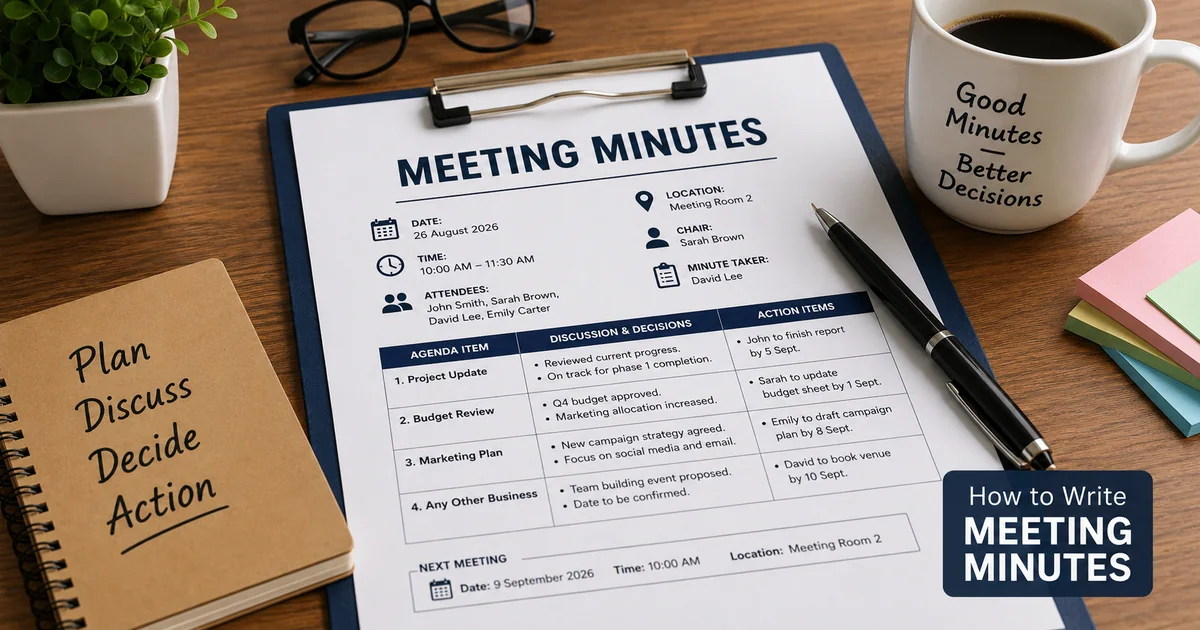
Being asked to take meeting minutes can feel difficult, especially when several people are talking, decisions are being made quickly and you are trying to work out what actually needs to be recorded.
The good news is that effective minutes do not require you to write down every word.
To write meeting minutes well, record the basic meeting details, follow the agenda, summarise the important discussion, clearly document every decision, and give each agreed action an owner and deadline. After the meeting, write the minutes up promptly, check them for accuracy and circulate them to the appropriate people.
Good minutes should help someone understand what was decided and what needs to happen next without having to attend the meeting themselves.
What Are Meeting Minutes?
Meeting minutes are the structured written record of a meeting.
They normally document:
- When and where the meeting took place
- Who attended
- Who sent apologies or was absent, where relevant
- The agenda items discussed
- Important decisions
- Actions agreed
- Who is responsible for each action
- Deadlines
- The date of the next meeting, if known
Minutes are different from personal meeting notes.
Your own notes might include reminders, ideas or details that matter only to you. Meeting minutes are normally shared with a wider group and should provide a clear, neutral record.
The UK Cabinet Office provides an official guide to taking professional meeting minutes:
Meeting Minutes vs Meeting Notes vs a Transcript
These three terms are sometimes treated as if they mean the same thing, but they serve different purposes.
Meeting Notes
Notes are usually informal. They can contain personal reminders, rough ideas and observations.
Meeting Minutes
Minutes are an organised record of the meeting. They focus on decisions, actions and important discussion points.
Transcript
A transcript attempts to record what was said word for word.
For most normal workplace meetings, a transcript contains far more detail than useful minutes need.
The aim is not to recreate the conversation. The aim is to preserve the outcome of the conversation.
What Should Meeting Minutes Include?
A reliable format starts with the basic meeting information.
At the top of the document, include:
Meeting title: Monthly Operations Meeting
Date: 29 August 2026
Time: 10:00 am to 11:00 am
Location: Conference Room 2 / Microsoft Teams
Chair: Sarah Ahmed
Minute taker: James Wilson
Attendees: Names of those present
Apologies: Names of invited members who could not attend
You can then structure the main minutes according to the meeting agenda.
For each agenda item, capture three things whenever possible:
Discussion: What important issue was considered?
Decision: What did the group agree?
Action: Who will do what, and by when?
That simple structure prevents meeting minutes from turning into pages of unnecessary conversation.
How to Write Meeting Minutes Step by Step
1. Prepare Before the Meeting
Good minute taking starts before anyone enters the room.
Get a copy of the agenda in advance.
If this is a regular meeting, read the previous minutes as well. This helps you understand unfinished actions, recurring topics and the format normally used by the organisation.
Create your document headings before the meeting starts.
For example:
- Welcome and apologies
- Previous minutes
- Matters arising
- Sales update
- Staffing
- New business
- Actions
- Next meeting
You can then type notes directly beneath each section instead of trying to organise everything afterwards.
2. Record Attendance Accurately
Make a clear record of who attended.
For formal meetings, it may also be necessary to record:
- The chair
- The secretary or minute taker
- Members present
- Guests
- People attending remotely
- Apologies for absence
Do not guess names or job titles.
If you are unsure about someone’s name, confirm it before finalising the document.
3. Follow the Agenda
Use the meeting agenda as the structure for your minutes.
This makes the final document easier to read and allows people to find a specific discussion later.
If the conversation moves away from the agenda and later returns to an earlier topic, organise the final minutes logically rather than copying the exact order in which people spoke.
Your job is to produce a useful record, not a running commentary.
4. Focus on Decisions Rather Than Every Comment
One of the biggest mistakes new minute takers make is trying to type everything.
Imagine a team spends ten minutes discussing whether to launch a new customer survey.
You probably do not need five paragraphs explaining every opinion.
A clearer minute might say:
“Members discussed customer feedback collection. It was agreed that a quarterly customer survey would be introduced from October.”
Then record the action:
“Action: Emma to prepare the first survey draft by 15 September.”
That tells the reader what mattered.
5. Write Clear Action Items
Actions are often the most valuable part of meeting minutes.
Avoid vague wording such as:
“Marketing to look into this.”
Instead write:
“Action: Daniel to obtain three quotations for the new website and circulate them to the management team by 12 September.”
A useful action should answer:
What needs to be done?
Who owns it?
When is it due?
If one of those details is unclear during the meeting, ask the chair to confirm it where appropriate.
For organisations managing several compliance or reporting processes, structured record keeping becomes especially important. You may also find this related Business article useful:
6. Keep the Language Neutral
Meeting minutes should normally be factual and professional.
Avoid emotional or judgemental language.
Instead of writing:
“John strongly complained that the previous system was terrible.”
Write:
“John raised concerns about delays caused by the previous system.”
Do not add your personal opinion.
If disagreement is important to the decision, record it objectively.
For example:
“Members discussed both options. The majority supported Option B.”
Formal organisations may require individual votes or objections to be recorded. Follow the organisation’s normal procedure where this applies.
7. Write the Minutes Soon After the Meeting
Do not leave rough notes untouched for several days if you can avoid it.
Write the first clean version while the meeting is still fresh in your mind.
Check:
- Names
- Dates
- Numbers
- Decisions
- Action owners
- Deadlines
- Next meeting details
If something important is unclear, confirm it with the chair rather than inventing the missing detail.
A Simple Meeting Minutes Template
You can use the following structure for many everyday business meetings.
Meeting Details
Meeting:
Date:
Time:
Location:
Chair:
Minute taker:
Present:
Apologies:
1. Previous Minutes
Record whether the previous minutes were accepted and any corrections required.
2. Matters Arising
Record important updates from previous actions.
3. Agenda Item One
Summary: Brief description of the important discussion.
Decision: What was agreed.
Action: Name, task and deadline.
4. Agenda Item Two
Summary:
Decision:
Action:
5. Any Other Business
Record relevant additional items.
6. Next Meeting
Date:
Time:
Location:
Example of Good Meeting Minutes
Website Project Meeting
Date: 29 August 2026
Time: 2:00 pm
Chair: Michael Brown
Attendees: Michael Brown, Hannah Ali, David Smith
Apologies: Rebecca Jones
Website Launch
The team reviewed progress on the new company website.
Decision: The launch date was moved from 10 September to 17 September to allow additional testing.
Action: David to complete mobile testing by 8 September.
Staff Training
Hannah reported that the new software training materials were almost complete.
Decision: Training will be delivered in two sessions.
Action: Hannah to circulate the final training schedule by 5 September.
Next Meeting
The next project meeting will take place on 12 September at 2:00 pm.
Notice how the example records the outcome rather than every sentence spoken during the discussion.
Common Meeting Minute Mistakes
Writing Everything Down
Minutes should summarise what matters. They should not normally reproduce the entire conversation.
Forgetting Deadlines
“Sarah will prepare the report” is less useful than “Sarah will prepare the report by 10 September.”
Failing to Identify Action Owners
Every meaningful action should have a clearly identified person or team responsible for completing it.
Adding Personal Opinions
Minutes should remain neutral.
Waiting Too Long to Write Them
Important context becomes harder to remember as time passes.
Making Minutes Too Vague
“Budget discussed” tells the reader almost nothing.
A better entry is:
“The proposed Q4 marketing budget was reviewed and approved at £15,000.”
How Soon Should Meeting Minutes Be Sent?
There is no single timetable that suits every organisation.
For routine workplace meetings, sending minutes promptly is good practice because action owners need enough time to complete their tasks.
Formal boards, committees and regulated organisations may have their own approval and circulation procedures.
If your workplace already has a minutes policy or standard template, follow it.
You can browse more practical workplace and business content in the 2DayTimes Business section:
You can also visit the 2DayTimes homepage:
Frequently Asked Questions
What is the easiest way to write meeting minutes?
Prepare a template using the agenda before the meeting. During the meeting, record important decisions and actions. Afterwards, rewrite the notes clearly and confirm every action owner and deadline.
Do meeting minutes include everything everyone said?
Usually not. Most useful minutes summarise key discussion points, decisions and agreed actions rather than producing a word-for-word transcript.
Should names be included in meeting minutes?
Names are normally included in the attendance section. Whether individual comments should be attributed depends on the organisation and type of meeting.
Who normally writes meeting minutes?
The task may be handled by a secretary, administrator, executive assistant, governance professional or another person appointed to take the record.
Should meeting minutes be written in past tense?
Past tense is commonly used because the minutes describe a meeting that has already taken place. More important than any single style choice is using clear and consistent language.
Do meeting minutes need approval?
Formal committees and boards often approve previous minutes at a later meeting. Informal workplace meetings may use a simpler circulation and correction process. Follow your organisation’s procedure.
Final Thoughts
Learning how to write meeting minutes becomes much easier when you stop trying to record every word.
Prepare before the meeting, follow the agenda, listen for decisions and turn every important commitment into a clear action with an owner and deadline.
Afterwards, write the minutes promptly and remove anything that does not help readers understand what was agreed or what needs to happen next.
The best meeting minutes are not necessarily the longest. They are the ones that make responsibilities, decisions and next steps impossible to misunderstand.