
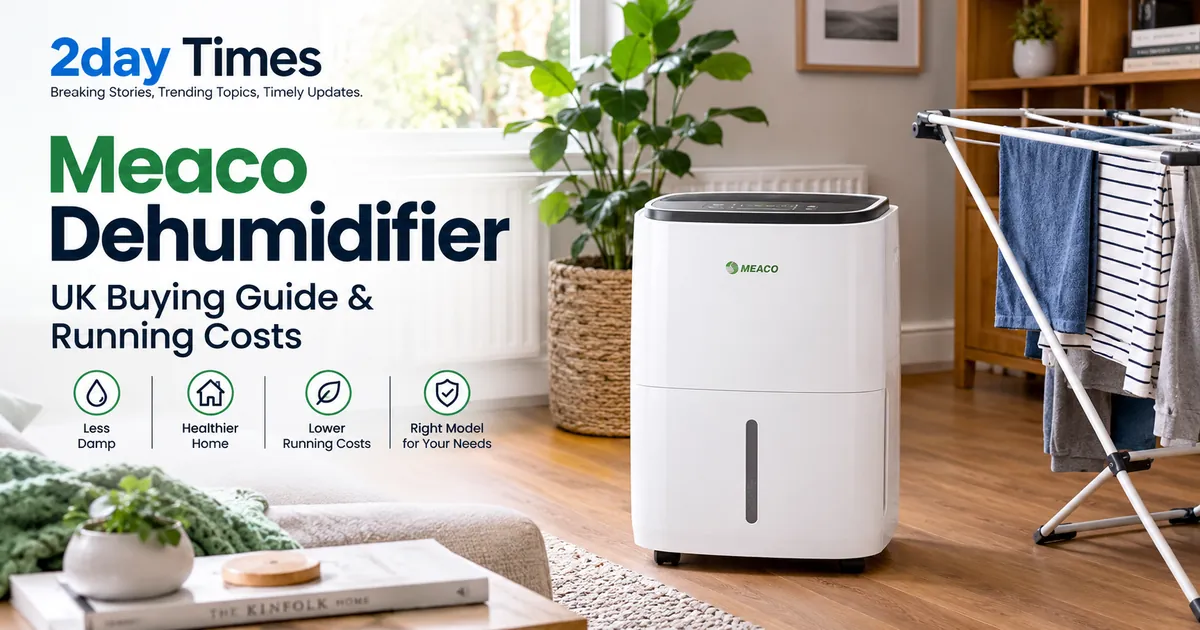
A Meaco dehumidifier can be a useful investment if your home suffers from excess moisture, wet windows or laundry that takes ages to dry. But choosing the right one is not simply about buying the model with the biggest water tank or highest extraction capacity.
Meaco offers several options, including the Arete One, Arete Two and DD8L desiccant ranges. They differ in performance, energy consumption, controls and suitability for colder rooms.
This guide explains the main differences, what they cost to run and which features are worth paying for, so you can choose a dehumidifier that suits your home.
What Makes a Meaco Dehumidifier Worth Considering?
Meaco is a British company specialising in humidity control and air treatment. Its dehumidifiers are designed to remove moisture from indoor air, helping manage condensation and making it easier to dry washing indoors.
Several features make its products appealing to UK households:
- Automatic humidity control: Selected models monitor humidity and adjust operation to maintain a target level.
- Laundry drying modes: Useful when outdoor drying is impractical.
- Relatively quiet operation: Certain Arete models start at approximately 35 dB.
- Energy-conscious design: Compressor models can be economical in regularly heated rooms.
- Air filtration: Many Arete models support optional HEPA filtration.
- Continuous drainage: Compatible models can drain water through a hose instead of relying solely on the collection tank.
However, these features vary by model. A more expensive dehumidifier is not automatically the best choice for every household.
Meaco Arete One vs Arete Two: What’s the Difference?
Two of Meaco’s main domestic ranges are Arete One and Arete Two. Both use compressor technology to collect moisture, but Arete Two introduces updated controls and additional features.
| Feature | Arete One | Arete Two |
|---|---|---|
| Technology | Compressor | Compressor |
| Humidity control | Automatic | Automatic |
| Laundry mode | Yes | Yes, with enhanced performance |
| Smart connectivity | No standard app control | App control on supported models |
| Motor | Conventional AC design | Updated DC motor design |
| Air filtration | Optional HEPA | Optional HEPA |
| Main advantage | Straightforward operation | Greater control and improved efficiency |
Independent testing by Expert Reviews found that the Arete Two 20L offered particularly strong moisture extraction and laundry-drying performance compared with its predecessor.
The difference matters most if you regularly dry clothes indoors or want the convenience of app-based controls.
For someone who simply wants to manage occasional condensation in a small bedroom, an Arete One may still be perfectly adequate.
Which Meaco Dehumidifier Size Do You Need?
The number printed on a dehumidifier, such as 10L, 12L or 20L, refers to its rated maximum water extraction over 24 hours under specified test conditions.
It does not mean the appliance will collect that amount every day in a typical British home.
Actual extraction depends on temperature, relative humidity and the amount of moisture entering the room.
Meaco 10L or 12L: For Smaller Homes
A 10L or 12L model is a reasonable starting point for a flat, bedroom or smaller home with moderate moisture problems.
The Arete Two 12L is marketed by Meaco for homes with up to three bedrooms. It offers a compact design, laundry mode and automatic humidity control.
Choose this size when space is limited and you are mainly dealing with everyday condensation rather than severe damp.
Meaco 20L: For Larger or Wetter Spaces
A Meaco 20L dehumidifier is worth considering if you have several damp rooms, regularly dry family-sized loads of washing indoors or need faster moisture removal.
The Arete Two 20L is marketed for properties with up to four bedrooms.
Its larger extraction capacity can be useful, although you should expect a bigger appliance and potentially higher electricity consumption while actively extracting moisture.
Meaco 25L: For High Moisture Demand
A 25L model is intended for more demanding situations, including larger households and substantial laundry-drying requirements.
Do not choose it purely because your property has several bedrooms. A smaller model may be adequate if humidity levels are already reasonably controlled.
Practical tip: Measure humidity with a separate hygrometer before buying. If readings regularly exceed 60% relative humidity, especially alongside condensation, investigate the moisture source and consider a suitable dehumidifier.
Compressor vs Desiccant: Which Works Better in Winter?
This is one of the most important buying decisions.
Compressor Dehumidifiers
Compressor models cool incoming air so moisture condenses and collects in a tank.
They generally perform efficiently in regularly heated living spaces, making them suitable for most centrally heated UK homes.
The Arete One and Arete Two ranges use this technology.
Desiccant Dehumidifiers
Desiccant models use a moisture-absorbing material rather than relying on a cold refrigeration coil.
They can be particularly effective in colder environments, including unheated conservatories, garages and certain utility rooms.
Meaco’s DD8L range is an example.
As temperatures fall, smaller compressor dehumidifiers become less effective. Meaco advises that below approximately 10°C, desiccant technology is generally the better choice.
Before buying, check the actual temperature of the room where you intend to use the appliance. A warm bedroom and a cold garage may require completely different machines.
How Much Does a Meaco Dehumidifier Cost to Run?
Electricity consumption depends on the model, fan setting, humidity level and how frequently the compressor or heating element operates.
Meaco’s published estimates for selected Arete Two models, using an assumed electricity price of 26.32p per kWh, are:
| Model | Indicative running cost |
|---|---|
| Arete Two 10L | 3.6p per hour |
| Arete Two 12L | 3.6p per hour |
| Arete Two 20L | 5.4p per hour |
| Arete Two 25L | 6.6p per hour |
These are manufacturer estimates, not guaranteed costs under all operating conditions.
For example, running a 20L model at the quoted 5.4p hourly rate for six hours would cost approximately 32p.
If it operated for six hours daily over 30 days at that rate, the estimated total would be £9.72.
Real costs may be lower when automatic humidity controls stop or reduce operation, or higher under different settings and electricity tariffs.
To estimate your own costs, use:
Power in watts ÷ 1,000 × operating hours × electricity price per kWh
For instance, a 200W appliance running for five hours at 25p per kWh would cost 25p.
Always compare the power consumption under relevant conditions, not just the headline extraction capacity.
How to Use a Meaco Dehumidifier Effectively
Buying an appropriate machine is only half the job. Placement and settings make a difference.
Set the Right Humidity Level
Meaco generally recommends targeting approximately 55% relative humidity.
This provides a practical balance between reducing excess moisture and avoiding unnecessarily dry air.
A setting between 50% and 55% is a sensible starting point for many UK living spaces.
Choose a Suitable Position
Place the appliance on a stable, level surface and follow the clearance instructions in its manual.
Some Arete models are specifically designed to sit close to a wall, but this should not be assumed for every Meaco dehumidifier.
Keep air inlets and outlets unobstructed.
Use Laundry Mode When Needed
For indoor washing, position the airer safely in a suitable room, close the windows while dehumidifying and use the laundry setting if available.
Do not drape clothing over the machine or block its airflow.
Once the washing is dry, switch back to normal humidity control.
Maintain the Filters and Tank
Empty the collection tank when necessary and clean the dust filter according to the manufacturer’s instructions.
Check whether any optional HEPA filter needs replacing rather than washing.
Regular maintenance helps preserve airflow and prevents unnecessary performance problems.
Can a Meaco Dehumidifier Help With Damp and Mould?
A dehumidifier can reduce airborne moisture, which may help limit condensation and conditions that encourage mould growth.
However, it cannot repair leaking pipes, failed waterproofing, penetrating damp or defective building materials.
If your windows regularly become wet, understanding the underlying cause is important. Our guide to reducing condensation on windows explains practical changes to ventilation, heating and everyday moisture control.
Use a dehumidifier as part of a wider moisture-management approach, not as a substitute for necessary property repairs.
Common Mistakes to Avoid When Buying
Choosing capacity by bedroom count alone: A heavily used laundry room may produce more moisture than several ordinary bedrooms.
Ignoring room temperature: A small compressor model might struggle in an unheated winter space where a desiccant alternative would perform better.
Assuming a 20L machine collects 20 litres daily: Rated extraction figures are measured under particular conditions and are not typical daily guarantees.
Running continuous mode unnecessarily: Automatic humidity control is often more economical for everyday use.
Expecting air purification without the correct filter: Check which filters are included and whether replacements cost extra.
Ignoring noise: Compare the decibel ratings and fan settings if the appliance will operate near a bedroom or workspace.
Frequently Asked Questions
Are Meaco dehumidifiers energy-efficient?
Many Meaco compressor models are designed for low electricity consumption, particularly in heated rooms. Actual efficiency depends on temperature, humidity and the amount of water extracted.
Is a 12L or 20L Meaco dehumidifier better?
A 12L model may suit a smaller property with moderate humidity. A 20L model is generally more appropriate for larger spaces or heavier laundry and moisture demands.
Can I leave a Meaco dehumidifier on overnight?
Models designed for unattended automatic humidity control can operate overnight when used according to their instructions. Ensure the appliance is positioned safely, its airflow is unobstructed and its electrical supply is suitable.
Why is my Meaco dehumidifier not collecting water?
The room may already be below the selected humidity target. Low temperatures, blocked filters, incorrect settings or a full water tank can also affect operation. Check the manual before assuming the appliance is faulty.
Do Meaco dehumidifiers heat a room?
Dehumidifiers release some heat during operation, but they are not replacements for conventional room heating. Desiccant models may noticeably warm the air they discharge.
Is a Meaco dehumidifier worth buying?
It can be worthwhile if excess indoor humidity is an ongoing problem. The best value comes from choosing the correct technology and extraction capacity rather than paying for features you will rarely use.
Conclusion
The best Meaco dehumidifier depends on your home’s temperature, size and moisture problems.
For smaller, regularly heated spaces, the Arete One or Arete Two 10L and 12L models are practical options. Larger households and frequent indoor laundry drying may benefit from the Arete Two 20L, while colder spaces can make a desiccant model a more sensible choice.
Before purchasing, measure your humidity levels, check your room temperature and compare running costs using your actual electricity tariff.
For current specifications, warranty conditions and model comparisons, consult the official Meaco dehumidifier range.